
6 min read
UWB, 6G, and Cellular ISAC: Enabling Intelligent Edge Sensing for Future Wireless Systems – A White Paper
Executive Summary
As the wireless industry accelerates toward the 6G era, one of the most significant architectural shifts is the evolution from communication-only networks into systems capable of understanding the physical world. Integrated Sensing and Communication (ISAC) is emerging as a foundational concept for future wireless systems, enabling networks to simultaneously communicate, localize, and sense.
While much of the industry discussion focuses on future Cellular ISAC and 3GPP evolution, Ultra-Wideband (UWB) technology already delivers many of these core capabilities in commercial deployments today. This white paper explores how UWB serves as a high-precision local sensing layer that complements the broader 6G vision.
The Convergence of Sensing and Communication
For decades, wireless systems were optimized for connectivity, throughput, and spectral efficiency. However, emerging applications such as autonomous robotics, immersive XR, digital twins, and smart factories require networks to understand context, motion, and spatial relationships in real time.
ISAC represents the convergence of communications, localization, and radar-like sensing. While cellular infrastructure focuses on wide-area sensing using massive MIMO, beamforming, and high-frequency spectrum, many practical applications also require short-range, centimeter-level precision that cellular systems alone may not efficiently deliver.
Technical Foundations of UWB as an ISAC Platform
UWB operates using extremely short pulses transmitted across wide bandwidths, typically around 500 MHz. The large bandwidth enables very fine time resolution, significantly improving ranging precision and multipath separation. The pulse-based architecture also supports low-latency data transfer and fast real-time interactions between devices.
Modern UWB systems enable precise localization by measuring both distance and angle between devices. Distance estimation is commonly based on Time-of-Flight (ToF) measurements, where the signal propagation time is converted into distance using the speed of light. Several ranging techniques can be used, including Two-Way Ranging (TWR) and Time Difference of Arrival (TDoA).
To achieve high timing accuracy, UWB systems use Channel Impulse Response (CIR) analysis to identify signal arrival paths and accurately estimate propagation delay. Multi-antenna implementations can additionally support Angle-of-Arrival (AoA) estimation for directional positioning.
Beyond localization, temporal analysis of CIR measurements across multiple transmissions enables higher-level sensing capabilities such as vital-sign monitoring, motion detection, occupancy sensing, and environmental awareness.
Power Consumption and Edge Efficiency
In addition to its precision capabilities, a defining advantage of UWB in the ISAC landscape is its superior power efficiency at the edge. While cellular-based sensing requires significant energy for high-frequency signal processing and continuous network synchronization, UWB’s short-pulse, low-duty-cycle architecture is inherently optimized for battery-constrained devices. This energy profile makes UWB particularly well suited for wearable health monitors, IoT sensors, and mobile accessories that require persistent spatial awareness without the substantial power overhead typically associated with wide-area cellular sensing infrastructure.
Evolution of Standards
IEEE 802.15.4z introduced enhanced secure ranging mechanisms designed to mitigate distance spoofing and relay attacks, a critical requirement for automotive and secure-access applications.
More importantly, these mechanisms establish the foundation for trusted localization and trusted spatial awareness capabilities that are becoming increasingly important in future sensing-aware wireless systems.
As ISAC architectures evolve, wireless networks will rely not only on trusted communication, but also on trusted sensing and positioning information. In this context, protecting the integrity of ranging and sensing data may become as important as securing the communication channel itself.
Meanwhile, the emerging IEEE 802.15.4ab standard extends operational range and improves localization performance under challenging Non-Line-of-Sight (NLoS) conditions, including heavily obstructed indoor environments.
UWB Already Delivers Practical ISAC
Unlike many future-oriented ISAC concepts, UWB already integrates communication, localization, and sensing in commercial products today.
Modern UWB deployments already enable:
- Secure seamless access and digital key systems
- “Find My” tracking ecosystems
- Indoor navigation
- Vital signs monitoring and Child Presence Detection (CPD)
- Industrial and logistics asset tracking
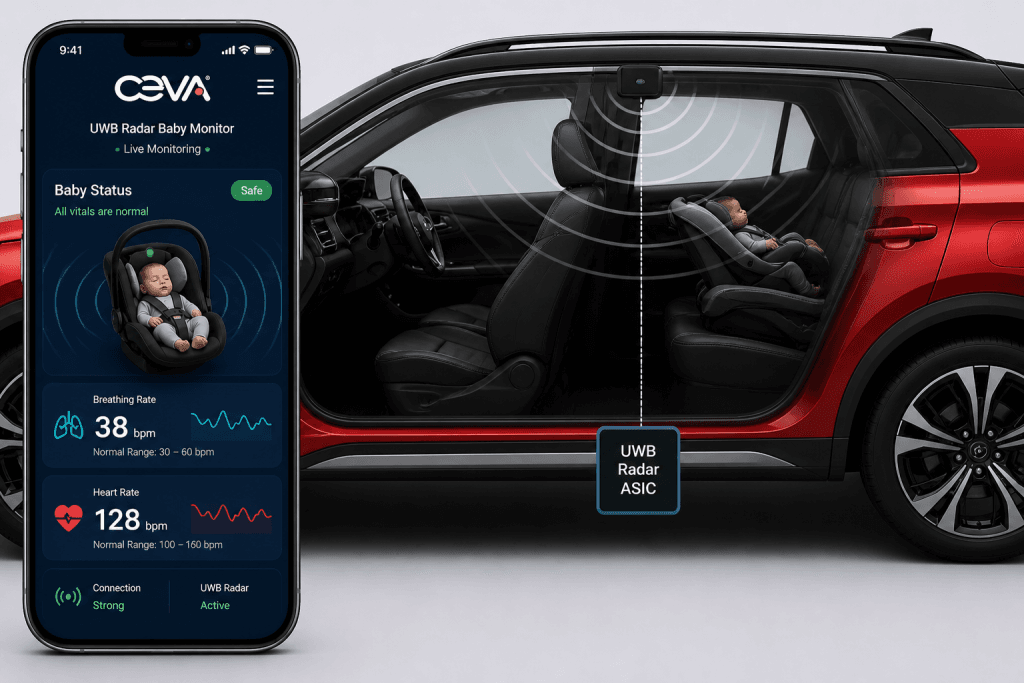
Figure 1 – Child Presence Detection in car cabin
These deployments demonstrate that practical sensing-aware wireless systems are already operating at scale across consumer, automotive, and industrial markets.
The Growing UWB Ecosystem
Over the last several years, UWB has evolved from a niche positioning technology into a rapidly expanding wireless ecosystem supported by major players across the mobile, automotive, and semiconductor industries.
Industry projections indicate that UWB support could reach approximately 56% of smartphones by 2029.
The automotive industry is also increasing investment in UWB technology for digital key systems and in-cabin sensing applications. Much of this ecosystem development is supported by the Car Connectivity Consortium (CCC), which promotes interoperable digital-key standards across the automotive industry.
At the ecosystem level, the FiRa Consortium plays an important role in promoting interoperability, certification, ecosystem development, and new UWB use cases.
This ecosystem momentum demonstrates that spatial-awareness capabilities are becoming a native part of modern wireless platforms.
Spectrum Strategy and Regulatory Resilience
Coexistence with future wireless systems is becoming increasingly important as spectrum grows more crowded.
One example is coexistence with Wi‑Fi 6E and Wi‑Fi 7 operating in the 6 GHz band. Portions of the UWB spectrum around 6.5 GHz overlap with these Wi‑Fi deployments. Because Wi‑Fi transmit power is significantly higher than UWB power levels, practical UWB deployments increasingly prefer operation around the 8 GHz region, where coexistence conditions are generally more favorable.
At the same time, future coexistence with high-power IMT and 6G systems may introduce additional challenges. Advanced cellular beamforming systems may introduce interference dynamics for nearby UWB receivers, potentially impacting ranging accuracy, synchronization, and sensing reliability.
The 7.4–8.4 GHz spectrum segment is therefore gaining strategic importance. Recent regulatory developments in the United States excluded these frequencies from broader commercial spectrum reallocation discussions due to their importance for military satellite communications and other government systems. Portions of this spectrum are also used for commercial applications including UWB communications.
This creates a relatively stable spectrum environment for UWB deployments in the upper 7 GHz / lower 8 GHz region.
Deployment Architectures: Scalability and Precision
UWB supports multiple deployment models suitable for both consumer and industrial environments.
In addition to network-based positioning architectures, UWB also supports direct point-to-point ranging between devices. This can be used between smartphones, wearables, vehicles, tags, or other connected devices to estimate distance with centimeter-level precision. Such peer-to-peer ranging forms the foundation for applications such as digital keys, device finding, secure access, and spatial interaction.
In Downlink TDoA systems, infrastructure anchors transmit synchronized signals while the mobile device computes its own position locally. This enables anonymous indoor navigation and privacy-oriented positioning.
In Uplink TDoA systems, the infrastructure computes device locations centrally, enabling large-scale industrial asset tracking and fleet management.
Phase Difference of Arrival (PDoA) techniques additionally allow systems to estimate both distance and Angle-of-Arrival using multiple antennas, providing the foundation for directional positioning and advanced spatial sensing capabilities.
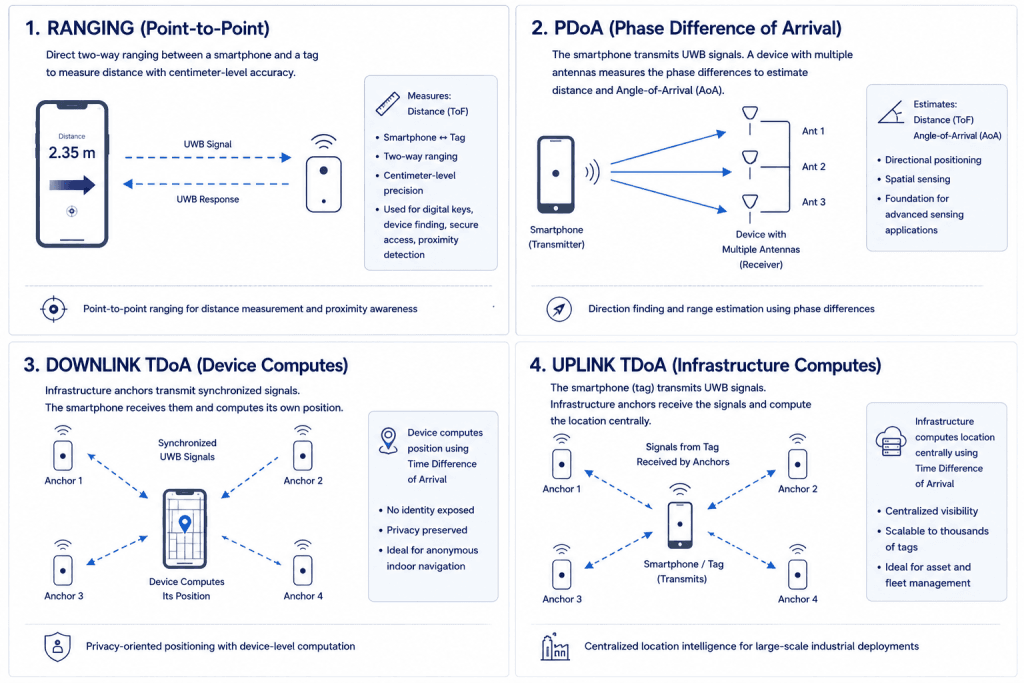
Figure 2 – Deployment example
Integration into Future 6G Architectures
Future 6G systems are unlikely to rely on a single sensing modality. Instead, sensing-aware wireless architectures will likely combine multiple technologies operating at different spatial scales and accuracy levels.
In such architectures, Cellular ISAC may provide wide-area environmental awareness, mobility support, and macro-level sensing using existing network infrastructure. UWB, by contrast, is well positioned to serve as a high-precision local sensing layer, enabling accurate ranging, indoor positioning, secure spatial interaction, and fine-grained environmental awareness.
This creates opportunities for multi-layer sensing frameworks in which:
- Cellular infrastructure provides large-scale sensing coverage
- UWB delivers local precision and secure ranging
- AI systems fuse information from multiple sensing modalities
- Digital twins maintain real-time representations of physical environments
Future intelligent environments are also expected to rely heavily on sensor fusion architectures combining UWB with Cellular ISAC, radar, LiDAR, cameras, and inertial sensors. Rather than functioning as isolated systems, future sensing-aware platforms may dynamically orchestrate multiple sensing technologies depending on application requirements, accuracy targets, latency constraints, power consumption, privacy requirements, and environmental conditions.
As future sensing-aware wireless systems become increasingly integrated into industrial automation, transportation, robotics, and smart infrastructure, trusted sensing and trusted localization will become critical architectural requirements.
Future ISAC systems will rely not only on secure communication channels, but also on the integrity of spatial-awareness information such as ranging, positioning, occupancy detection, and environmental sensing. In this context, technologies capable of secure ranging and trusted distance estimation may play an important role in enabling reliable and trustworthy sensing-aware wireless environments.
Rather than competing with Cellular ISAC, UWB is increasingly positioned as a complementary sensing technology that extends future 6G architectures with highly accurate local spatial awareness and secure interaction capabilities.
Privacy-by-Design: A Competitive Advantage
Unlike camera-based systems, UWB sensing relies on RF reflections rather than optical imaging. This allows systems to detect movement, monitor breathing, measure occupancy, and identify activity patterns without capturing identifiable visual information.
This privacy-centric sensing model makes UWB particularly attractive for healthcare, smart homes, automotive cabins, and ambient intelligence environments.
Conclusion: A Multi-Modal Future
UWB and Cellular ISAC are not competing technologies; they address different scales of environmental awareness.
Cellular ISAC will provide macro-level network sensing and wide-area awareness, while UWB excels at fine-grained, secure local interaction and precise spatial sensing.
Future intelligent environments will likely rely on sensor fusion architectures combining UWB with Cellular ISAC, radar, LiDAR, cameras, and inertial sensors to create dynamic real-time digital twins.
By delivering practical sensing capabilities today, UWB is establishing itself as the precision local layer for the next generation of spatially aware wireless ecosystems.

Navot Goren