
8 min read
How licensed IP shifts engineering focus from foundational plumbing to the problems that actually create product value – while accelerating time-to-market and reducing program risk
There’s an unspoken assumption in many engineering cultures: that building something internally is inherently more rigorous, more differentiated, more real than licensing it. It’s a reasonable instinct. It’s also increasingly expensive to act on.
The question modern SoC teams face isn’t whether to use third-party IP. It’s where internal engineering effort creates irreplaceable competitive value – and where it doesn’t. Getting that boundary wrong is one of the most common sources of program delays, cost overruns, and first-silicon failures in the industry today.
Silicon IP has emerged as a critical enabler for accelerating SoC design, product development and reducing time-to-market. By integrating pre-designed and pre-verified circuit blocks, teams can shorten design, testing, and validation cycles, reduce risk, and focus on the parts of the system that actually differentiate the product in market.
The real cost of building foundational blocks from scratch
For IP blocks that implement industry standards – wireless connectivity, DSP functions, AI accelerators – the economics of in-house development are rarely favorable unless the organization can sustain a multi-year investment and the IP itself is the primary source of product differentiation.
In practice, that’s a high bar. Internal development of these blocks typically means:
- Multi-year design and debug cycles that compete with shrinking market windows
- A verification burden that consumes engineering capacity disproportionate to the value created
- Higher first-silicon risk, because the IP hasn’t been exercised across process nodes, operating conditions, and real-world use cases at scale
- Ongoing standards tracking and certification maintenance as protocols evolve
None of this is insurmountable. But it represents engineering effort spent on infrastructure rather than on the system-level problems where your team’s expertise actually compounds.
The standards trap: where in-house development creates cost without differentiation
The economics of internal IP development become hardest to justify for standards-based technologies. Bluetooth, Wi-Fi, 5G – these protocols are defined by industry bodies specifically to ensure interoperability. Every compliant implementation must behave the same way at the interface level. That’s the point.
Which means that a team spending two to three years building an in-house Bluetooth stack isn’t creating differentiation. They’re creating a functionally equivalent implementation of something that already exists in production-proven form – at significant cost in engineering time, verification effort, and schedule risk.
Wireless connectivity – Bluetooth, Wi-Fi, UWB, cellular – is infrastructure. It’s a box that has to be ticked on almost every modern SoC. The differentiation in a connected product comes from the system architecture, the application layer, and the intelligence running on top of the silicon. Not from whether the connectivity stack was developed internally or licensed. For these blocks, the build vs. license question isn’t a strategic tradeoff – it’s a resource allocation decision in disguise.
Wireless connectivity is commodity infrastructure. Every compliant Bluetooth, Wi-Fi, or 5G implementation must behave identically at the interface – that’s what a standard is. No amount of internal development changes that. The differentiation lives above the silicon, not in it.
What licensed IP actually enables
This is where the ‘not invented here’ framing misses the point. Licensed IP isn’t a substitute for engineering talent – it’s what allows that talent to operate at a higher level of abstraction.
When a team licenses proven wireless connectivity or edge AI IP, they’re not outsourcing the hard parts. They’re removing a known-cost, known-timeline block from the critical path so their engineers can focus on the architecture decisions, integration challenges, and system-level differentiation that define what makes their product competitive.
Pre-verified IP that has shipped across billions of devices brings something internal development can’t replicate early in a program: certainty. Certainty about timing closure, power behavior, protocol compliance, and integration risk. That certainty has real value in a world where SoC schedules are measured in years and respins are measured in millions of dollars.
It also helps accelerate product launches in a practical way. IP providers typically offer comprehensive documentation, simulation models, integration support, and complementary ecosystem offerings. That means teams can move more quickly from design to prototyping and full production while reducing the risk of costly design errors.
| Dimension | Licensed IP | In-house IP |
| Time-to-market | Shorter; pre-verified, production-proven IP avoids multi-year debug cycles | Longer; IP development often becomes a critical path risk |
| Engineering focus | Core effort redirected to system architecture and differentiation | Full design, verification, and maintenance burden retained internally |
| Risk profile | Lower technical and schedule risk; IP deployed at scale across process nodes | Higher risk of late-stage issues; respins tied to IP-level failures |
| Cost structure | License fee + royalties; lower OPEX, predictable budgeting | High upfront OPEX (5-10x); costs amortized only at very high volumes |
| Verification load | Primarily system-level and integration verification | Full functional and corner-case verification required |
| Connectivity coverage | All major wireless standards available from a single vendor, reducing integration complexity across multi-protocol SoCs | Building and maintaining multiple standards-based stacks internally multiplies verification burden and standards tracking cost |
| Standards compliance | Vendor-managed updates track protocol evolution and certification | Ongoing standards tracking adds maintenance and compliance burden |
Three examples of where licensed IP changes the economics
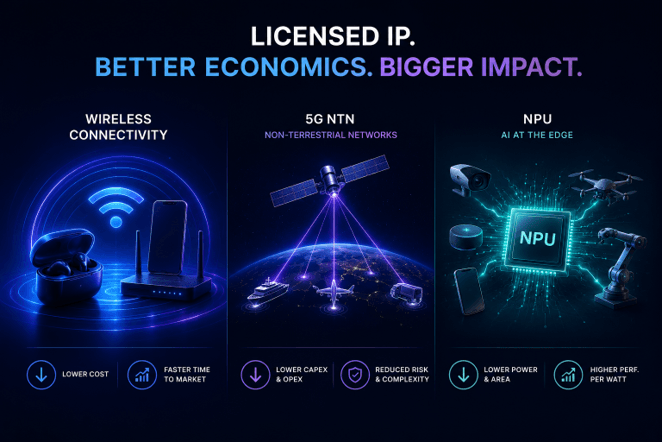
The pattern is easiest to see in real categories where standards compliance, integration complexity, and time-to-market pressure all collide. Wireless connectivity, 5G-NTN, and Neural Processing Units (NPUs) accelerating AI workloads may serve very different end markets, but they expose the same underlying truth: when the foundational capability is complex, standards-based, and not the primary source of product differentiation, licensed IP gives teams a faster and lower-risk path to market while preserving freedom to innovate at the system level.
Integrated wireless connectivity is now a system-level requirement
Wireless connectivity is becoming a system-level challenge, not a block-level one. As more devices require support for multiple standards and more advanced user experiences, the value shifts from owning each protocol implementation to integrating them successfully into one robust, efficient, standards-based foundation. That is where licensed IP creates leverage. By working with a partner that brings expertise across the full connectivity stack and delivers those capabilities as one proven, pre-integrated platform, SoC teams can avoid fragmented development paths, reduce interoperability and coexistence risk, and move faster toward differentiated products.
5G-NTN: a case study in standards as table stakes
The satellite connectivity market illustrates this clearly. Operators and terminal manufacturers building LEO user terminals face a specific challenge: their core expertise lies in constellation design, spacecraft systems, and satellite link engineering. That’s where their differentiation lives, and it’s genuinely hard to replicate.
But to participate in the broader 5G ecosystem – to be compatible with terrestrial cellular networks, to leverage the cost efficiencies of cellular chipset supply chains, to meet operator requirements for standards-based connectivity – satellite OEMs need a 5G-NTN modem. And 5G-NTN is a 3GPP standard. Like Bluetooth or Wi-Fi, a compliant implementation must interoperate with every other compliant implementation. The standard defines the interface; it doesn’t differentiate the product.
This creates an uncomfortable situation for satellite-native organizations: they’re being asked to build deep cellular modem expertise – a discipline historically concentrated in a small number of specialist companies – to deliver a capability that won’t make their satellite more competitive. It will simply make it compatible.
Licensing a production-ready 5G-NTN modem subsystem resolves this directly. It removes the standards complexity from the critical path, allows satellite engineering teams to stay focused on the system-level problems where their expertise compounds, and preserves full flexibility to integrate proprietary technologies alongside the standards-compliant foundation. The modem handles compatibility. The OEM owns the differentiation.
The Neural Processing Unit (NPU) inflection point: the next CPU
There’s a useful historical parallel for where the NPU sits today.
Twenty years ago, some semiconductor teams still debated whether to develop custom CPU cores. Today, almost nobody does. The compute architecture is licensed – from Arm, from RISC-V ecosystem vendors, from processor IP specialists – and the engineering investment goes into the system around it: memory hierarchy, interconnect, security, application-specific acceleration. The CPU became infrastructure. Differentiation moved up the stack.
The NPU is at the same inflection point.
Edge AI inference is rapidly becoming a standard requirement across consumer, industrial, and automotive SoCs. Devices that don’t include an NPU for accelerating AI workloads will simply be uncompetitive on power efficiency and real-time AI capability. That makes the NPU, like the CPU before it, a must-have block – and must-have blocks follow a predictable pattern in the semiconductor industry. Over time, the ROI on building them internally collapses, and the engineering value shifts to what runs on top of them.
The teams winning in edge AI aren’t winning because they designed a better NPU. They’re winning because they have better models, better training pipelines, better application-specific optimization, and deeper understanding of how to extract performance from the hardware they have. That’s the work that compounds. That’s where proprietary expertise becomes a durable competitive advantage.
An in-house NPU development program doesn’t protect that advantage – it defers it. Every engineering cycle spent on microarchitecture, verification, and toolchain development is a cycle not spent on the model optimization and application intelligence that will actually differentiate the product in market.
The parallel to CPU, GPU, and DSP licensing isn’t just an analogy. It’s a roadmap. The semiconductor industry has already solved this problem for every other major compute block. The NPU is next.
How to choose the right IP partner
Choosing the right IP supplier is essential to successful integration. The ideal provider should have a proven track record of silicon-proven IP, offering reliability and scalability.
They should also provide robust technical support, clear and flexible licensing terms, and compatibility with common EDA tools and fabrication processes. Long-term support and regular updates matter as well, especially for standards-based functions and product lines with long lifecycles.
Best practice is straightforward: integrate proven IP early, test continuously, maintain good version control, document IP usage centrally, and work closely with the vendor for tuning and debugging. The goal is not just to buy a block. It’s to remove uncertainty from the program.
Where in-house development still makes sense
To be clear: internal IP development is the right answer when control of a specific block directly and sustainably enables competitive advantage – when a custom microarchitecture delivers measurable gains that licensed IP cannot match through configuration or integration alone.
That path requires long development horizons, deep domain expertise, and willingness to absorb verification and maintenance costs across multiple product generations. When those conditions exist, build. When they don’t, licensing is typically the more efficient path to a better product.
The distinction matters. It’s not about capability – it’s about where capability is best deployed.
The force multiplier
The teams that navigate this well don’t treat licensed IP as a shortcut. They treat it as leverage – a way to compress schedule, reduce risk, and reclaim engineering focus for the parts of the system where their decisions actually create product value.
This is especially true for edge AI and Physical AI devices, where the challenge has shifted beyond raw compute. The competitive edge today is the ability to deliver real-time perception, context awareness, and secure local decision-making – in a minimal silicon footprint, at the power envelope the application demands. That system-level problem is where engineering talent should be concentrated. Proven IP handles the foundation so your team can own the architecture.
The best chip teams aren’t the ones that build the most. They’re the ones that build the right things.
Ceva powers the Smart Edge, bridging the digital and physical worlds to bring AI-driven products to life. www.ceva-ip.com

Michal Rutzky
Director of Corporate Marketing